By QLD Water Filtration Team · Published · Updated . Prices are estimates for standard installations and are confirmed in your fixed quote.
What are the main types of water filters in Australia?
The main types of water filters in Australia are jug and benchtop filters, under-sink filters, reverse osmosis systems, whole-house filters, UV systems and water softeners. They use five technologies: sediment, activated carbon, reverse osmosis, UV and ion exchange, and most systems combine two or more.
Which one is right depends on your water, your home and what you want to fix. Here is each type in plain English, so you can pick with confidence.
The 5 filtration technologies, explained
Sediment filters catch particles, activated carbon improves taste and reduces chlorine, reverse osmosis takes drinking water further, UV deals with micro-organisms and ion exchange softens hard water. Each does a different job, which is why the best systems combine two or more of them.
| Technology | What it does | Where you will find it |
|---|---|---|
| Sediment filtration | Catches sand, silt and rust particles so the rest of the system works properly | Pre-filter stage in most systems |
| Activated carbon | Improves taste and smell and reduces chlorine and chloramine | Jugs, under-sink filters and whole-house systems |
| Reverse osmosis (RO) | Pushes water through an ultra-fine membrane to reduce dissolved salts, heavy metals, fluoride, PFAS and microscopic particles | Under-sink reverse osmosis systems |
| Ultraviolet (UV) | Neutralises bacteria and other micro-organisms without adding chemicals | Whole-home systems for tank, bore and rainwater supplies |
| Ion exchange (softening) | Swaps scale-causing minerals for soft ions so limescale stops building up | Water softeners |
Types of water filtration systems by where they go
Filters sit either at one tap (point-of-use) or at your mains (whole-house). Jug, benchtop, under-sink and reverse osmosis filters treat the water you drink at one tap, while whole-house, UV and softener systems treat all the water entering your home.
| Type | What it treats | Best for | Installed price |
|---|---|---|---|
| Jug or bottle filter | A jug at a time | Renters and tight budgets | Not installed |
| Benchtop filter | A small amount at the bench | Renters wanting more capacity | Not installed |
| Under-sink filter | Drinking and cooking water, from its own tap | Apartments, townhomes and budget-conscious families | From $1,190 |
| 5-stage reverse osmosis | Drinking and cooking water, filtered the finest | Households wanting the finest drinking water | From $1,590 |
| Whole-house filter | Every tap, shower and appliance | Suburban homes on city mains water | From $3,490 |
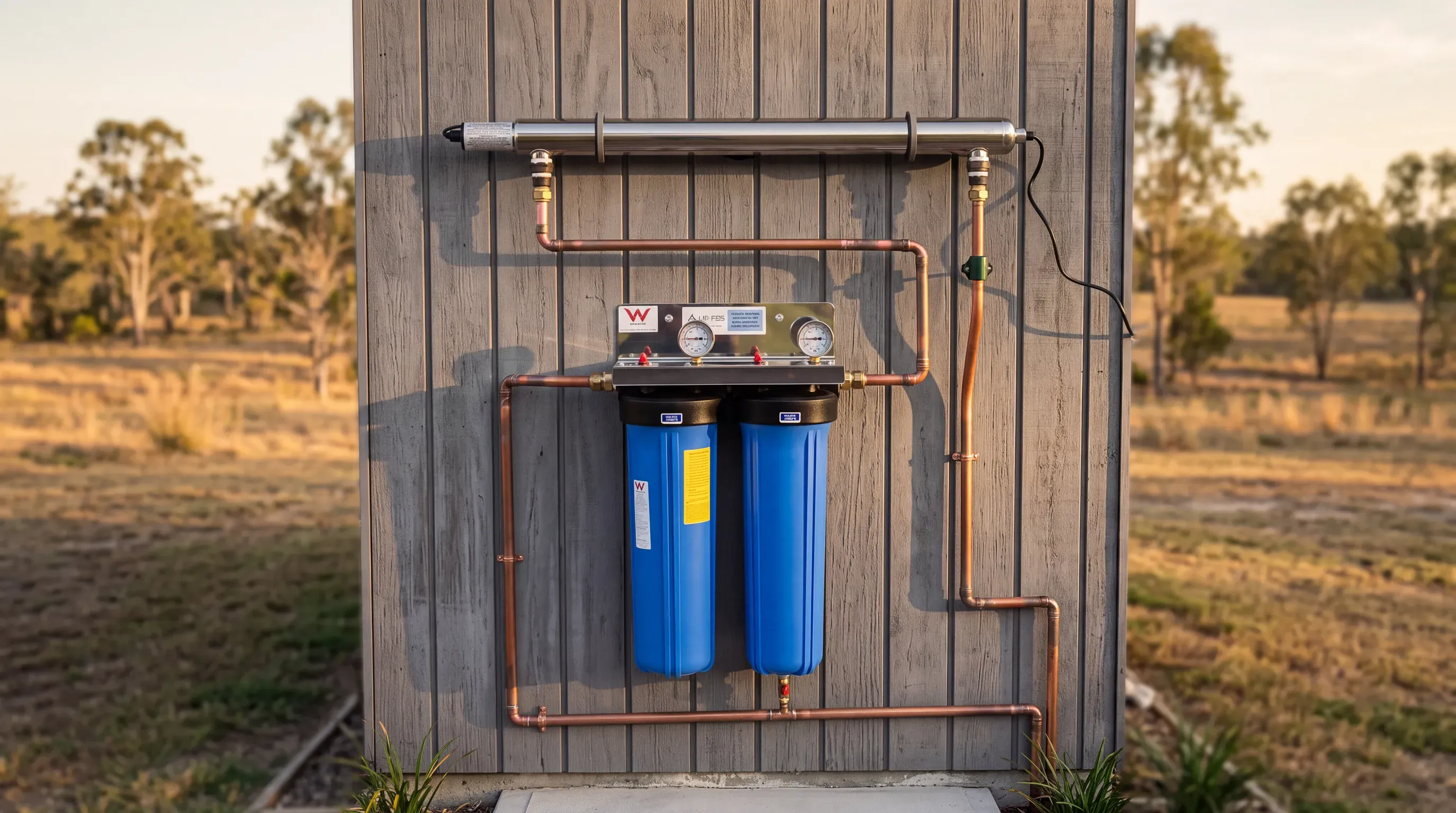
| Whole-home UV system | All water from a tank, bore or rainwater supply | Acreage, semi-rural and off-grid homes | From $4,690 |
| Water softener | All water, to stop limescale building up | Hard water, regional areas and bore water | From $5,490 |
You will also see small tap-mounted and shower filters. They are point-of-use filters that fit on a single outlet, and they are handy for a quick upgrade.
Which type of water filter suits your situation?
Match the type to the problem. Taste and chlorine at the kitchen tap point to an under-sink filter, the finest drinking water to reverse osmosis, every tap and shower to a whole-house system, limescale to a softener, and tank or bore water to UV.
| If you want... | Choose |
|---|---|
| Better-tasting drinking and cooking water | Under-sink filtration |
| The finest filtration for drinking water | 5-stage reverse osmosis |
| Filtered water at every tap and shower | Whole-house filtration |
| Less limescale, water spots and soap scum | Water softener |
| Safer-feeling tank, bore or rainwater | Whole-home UV system |
| To know what is in your water first | Free on-site water test |
Whole-house vs point-of-use: which is right for your home? →
What to look for when choosing a filter in Australia
Look for WaterMark-certified equipment, filtration that matches your water, a clear filter replacement schedule, a proper warranty and installation by a licensed plumber. WaterMark is the Australian mark for plumbing products, and a licensed install protects both your warranty and your plumbing.
- WaterMark certification, the Australian mark for plumbing products
- Systems that meet Australian Standards (AS 3497:2021)
- Filters that are easy and affordable to replace, usually every 6 to 12 months
- A real warranty: ours include a 12-month workmanship warranty, plus manufacturer warranties of 1 to 10 years
- Installation by a licensed plumber, so it is done right and your warranty stays valid
- A fixed-price quote, so there are no surprises
Not sure which type you need?
Book a free on-site water test. We check your water and plumbing and recommend the right system, with a fixed-price quote and no obligation.
How much do the different types of water filter cost?
Installed prices start from $1,190 for under-sink, $1,590 for reverse osmosis, $3,490 for whole-house, $4,690 for UV and $5,490 for a water softener. Every quote is fixed and no-obligation, and finance is available, including from $24 a week with Zip Pay on whole-house systems.
Most under-sink and reverse osmosis systems are installed in 2 to 3 hours. Whole-house, UV and softener systems usually take 3 to 4 hours. Filters then need replacing about every 6 to 12 months.
Find out which type your home needs
Book a free on-site water test. We test your water at your place, check your plumbing and recommend the right type of system for your home, then give you a fixed-price quote with no obligation at all.
Common questions
How do I know which filtration system is right for my home?
The best place to start is with a free in-home consultation. We test your water, assess your plumbing configuration and discuss your household's water usage and priorities. From there, we recommend a tailored configuration based on your water profile, lifestyle needs and installation requirements. No assumptions. No one-size-fits-all systems that may not do what you need them to.
Are your systems certified to Australian standards?
Yes. QLD Water Filtration systems are WaterMark certified and installed by licensed plumbers in accordance with Australian plumbing standards. This ensures safety, compliance and long-term performance.
How much does a system cost?
Broadly speaking, our fully installed systems start from $1,190 for an under-sink filter, with a 5-stage reverse osmosis upgrade from $1,590. The most affordable entry-level option is an under-sink system for drinking water ONLY. Whole-home systems start from $3,490, UV systems from $4,690 and water softeners from $5,490, and for the fully installed whole-home systems, exact pricing is influenced by factors such as the size of your home and family, the hardness of your water, the types of treatment chemicals used in your area, and more.
How long does installation take?
Most under-sink installations are completed within 2–3 hours. Whole-house, UV and water softener systems typically take 3–4 hours. We'll give you a clear timeline with your quote.
What are the different types of water filters?
The main types are jug and benchtop filters, under-sink filters, reverse osmosis systems, whole-house filters, UV systems and water softeners. They use sediment, activated carbon, reverse osmosis, UV or ion exchange technology, and many systems combine two or more.
What is the difference between a water filter and a water purifier?
A filter removes particles and substances such as chlorine to improve taste and clarity. The word purifier usually describes systems that also deal with micro-organisms, such as UV, or that go further, such as reverse osmosis. The two terms are not formally defined, so judge a system by what it reduces, not its label.
Which type of water filter is best for Australian tap water?
For city tap water, activated carbon filtration reduces chlorine and improves taste. An under-sink filter treats the kitchen tap and a whole-house system treats every tap and shower. For the finest drinking water, add reverse osmosis.
Do water filters remove fluoride?
Standard carbon filters are designed for taste and chlorine. Reverse osmosis reduces fluoride, along with PFAS, heavy metals and dissolved salts, so it is the type to choose if that matters to you.
Are jug filters worth it?
Jug filters are a low-cost way to improve taste, especially for renters. The trade-offs are small capacity, frequent cartridge changes and refilling. An under-sink system gives you filtered water on demand from its own tap, from $1,190 installed.
Do I need a plumber to install a water filter?
Plumbed-in systems such as under-sink, reverse osmosis, whole-house, UV and softener systems should be installed by a licensed plumber. Ours are fitted by licensed Queensland plumbers, which also protects your warranty.
Related services
Under-Sink Filtration
From $1,190 Fully Installed
Learn more →5-Stage Reverse Osmosis
From $1,590 Fully Installed
Learn more →Whole Home Filtration
From $3,490 Fully Installed
Learn more →Water Softener & Scale Protection
From $5,490 Fully Installed
Learn more →Whole Home UV System
From $4,690 Fully Installed
Learn more →More water filter guides
How Much Does Water Filter Installation Cost in Queensland? (2026 Prices)
Read the guide → Comparison GuideReverse Osmosis vs Whole-Home Filter vs UV: Which One Does Your Home Need?
Read the guide → Buyer's GuideDo You Need a Water Filter in Queensland? Here's How to Tell
Read the guide →Get your free quote
Get Your Free Quote
Fill in your details and we'll call you back within 30 min during business hours.